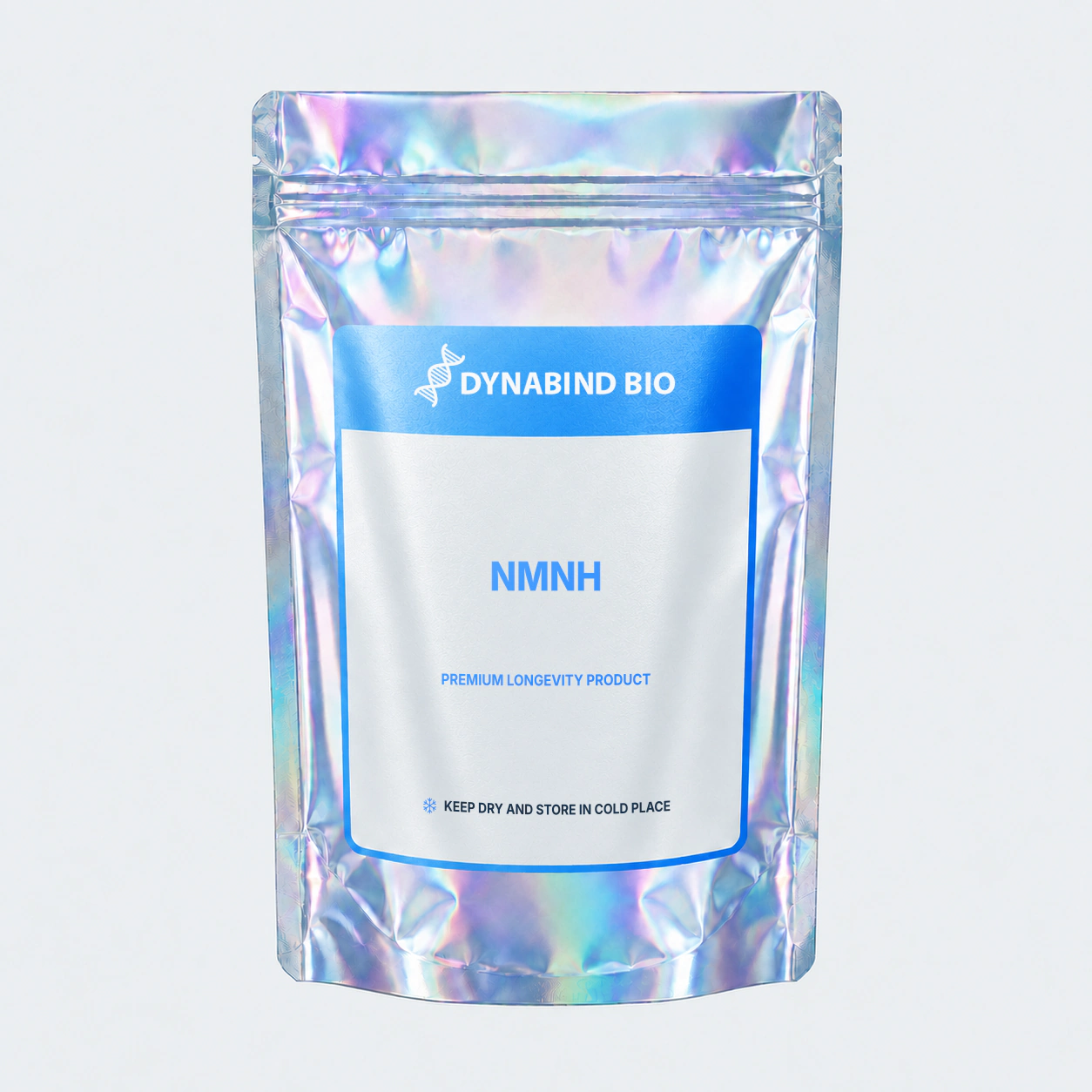
You've read that NMNH is "up to ten times more potent" than NMN. It's the line every vendor uses, including plenty who can't tell you where the number came from.
It's not invented. It comes from a real, well-conducted 2021 paper. But the number describes something more specific than most people assume, and if you're choosing between two compounds that cost real money, the specifics are the entire point.
Here is the honest comparison.
What Both Compounds Are Trying to Do
NAD⁺ is a coenzyme required for hundreds of reactions — ATP production, sirtuin activity, and the PARP enzymes that repair DNA breaks. Tissue NAD⁺ falls substantially with age. Every NAD⁺ precursor on the market exists to counteract that decline.
The difference between them is entirely about the route each takes to become NAD⁺ inside a cell, and how many enzymatic steps stand in the way.
NMN: The Well-Studied Option
NMN is one metabolic step from NAD⁺. Nicotinamide mononucleotide adenylyltransferase converts it directly. Simple, direct, and studied in humans more than any other precursor except nicotinamide riboside.
The strongest evidence:
Yoshino and colleagues (2021), in Science, ran a randomised placebo-controlled trial giving 250 mg NMN daily for ten weeks to prediabetic postmenopausal women. Muscle insulin sensitivity improved significantly versus placebo. Human trial
Multiple further trials have established oral NMN's safety across dose ranges and demonstrated dose-dependent increases in blood NAD⁺. Not every trial has shown functional benefit — some found NAD⁺ rose without measurable performance change — but the safety and pharmacokinetic picture in humans is reasonably well characterised.
That is NMN's real advantage, and it is not a small one: we know what it does in people.
NMNH: The More Potent Molecule — In the Lab
NMNH, or dihydronicotinamide mononucleotide, is NMN carrying two additional hydrogen atoms. That reduced state changes its metabolic behaviour considerably.
Zapata-Pérez and colleagues (2021) compared the two in cultured cells and in mice. NMNH raised intracellular NAD⁺ faster, and to substantially higher peak concentrations, than equimolar NMN. It appeared to reach NAD⁺ through a route distinct from the classical salvage pathway. Liu and colleagues reported convergent findings the same year. Preclinical
The "ten times" figure traces to these comparisons — peak NAD⁺ elevation in cells and mouse tissue.
What has not yet been published: a controlled human trial of NMNH. Not one showing a smaller effect — one has not been run and reported. The potency advantage is established in cells and rodents.
Side by Side
| NMN | NMNH | |
|---|---|---|
| Chemical form | Oxidised | Reduced (hydrogenated) |
| Steps to NAD⁺ | One (NMNAT) | Alternative route, bypasses salvage |
| Peak NAD⁺ rise (cells/mice) | Moderate | Substantially higher |
| Speed of rise | Slower | Faster |
| Published human RCTs | Several | None to date |
| Human safety data | Established across doses | Limited |
| Stability | Good, cool and dry | More oxygen-sensitive |
| Typical daily dose | 250–1000 mg | Considerably lower |
The Dosing Point Almost Nobody Makes
If NMNH genuinely produces a larger NAD⁺ rise per milligram, then dosing it like NMN is a mistake — and a common one. People buy NMNH, take an NMN-sized scoop, and are surprised by how strongly they feel it.
Higher potency means smaller doses, not a licence to take more of a stronger thing. Start at the low end. This is also a genuine argument for a pre-formulated stack over bulk powder: the Longevity Complex™ fixes the NMNH dose at a researched level, which removes the most common self-dosing error with this compound.
Stability matters more than with NMN
Reduced compounds oxidise. That's chemistry, not marketing. NMNH degrades faster than NMN on exposure to heat, moisture and air — which is exactly why third-party purity testing matters more here than for a stable compound. A certificate of analysis from the batch you're actually holding tells you whether you bought NMNH or partly-oxidised NMN at NMNH prices.
So Which Should You Buy?
Choose NMN if you want the compound with published human randomised trials behind it, you're new to NAD⁺ precursors, or you're taking medication and want the better-characterised safety profile.
Choose NMNH if you've already run NMN and want to try the compound with the stronger preclinical potency signal, and you're comfortable being ahead of the human evidence.
Consider both — they aren't mutually exclusive, and they appear to reach NAD⁺ by different routes.
One thing worth saying plainly, because the marketing around this category rarely does: raising NAD⁺ is a means, not an end. The reason to care is what NAD⁺ enables downstream — sirtuin signalling, PARP-mediated DNA repair, mitochondrial output. A precursor alone, without the compounds that act on those downstream pathways, is half a strategy.
Compare all NAD⁺ compounds →References
Yoshino M, et al. Science. 2021;372(6547):1224–1229. Human trial
Zapata-Pérez R, et al. FASEB J. 2021;35(4):e21456. Preclinical
Liu Y, et al. Reduced nicotinamide mononucleotide as an enhanced NAD⁺ precursor. 2021. Preclinical
These statements have not been evaluated by the Food and Drug Administration. Not intended to diagnose, treat, cure or prevent any disease. Consult a qualified healthcare professional before use.